The hunt was on. Having just returned to power in early 2025, President Trump had ordered agencies to root out government spending that promoted, in his view, “gender ideology extremism.” The problem was so widespread, Trump had promised, it required “historic action to defeat the toxic poison.”
At the U.S. Department of Agriculture, staff hustled to comply. They compared tens of thousands of contracts and grants to a list of terms to determine defunding. But, after about a week, little had been unearthed.
“The Department reached out to agencies to identify and cancel contracts that promote gender ideology, and ~7 contracts were identified,” reads a summary of the USDA’s actions in early February 2025. Staff “is following up with mission areas to ensure that no contracts were missed during this review process.”
Despite finding few contracts that matched the administration’s own definition of “gender ideology,” the USDA canceled more funding it claimed fit the bill over the next few months. For instance, in March 2025, Agriculture Secretary Brooke Rollins told Fox News a grant was recently canceled because it was for “food justice for trans people in New York and San Francisco.”
The sequence of events raises questions about how the USDA determined what to defund, especially at a time when the department likely faced pressure to follow through on the recently elected president’s rhetoric. It also demonstrates a political inconvenience for the Trump administration: the USDA is a largely socially conservative department — since the late 1990s, it has been sued repeatedly for denying financial support to minority and women farmers — which some believe makes it an odd target for right-wing attacks.
“I’m not surprised that they only found seven grants,” said Carolyn Sachs, a longtime rural sociologist at Penn State who has studied the intersection of gender and agriculture. “The USDA has been horribly sexist and horrible about promoting anything for LGBT and queer farmers. They just barely started doing some more things for women and LGBT farmers.”
Wanting to purge “gender ideology” — an apparent reference to trans people — is part of a broader Trump administration push to eliminate “diversity, equity and inclusion,” or DEI, initiatives from the entire government and beyond. Trump officials frequently lump “gender ideology” and DEI together.
Under the Trump administration's approach, Black and female generals have been denied promotions, and, lately, only white South Africans have been granted “refugee” status, typically reserved for people fleeing wartorn countries.
The USDA did not return requests for comment on the summary, which Investigate Midwest obtained through a public records request.
In 2024, the USDA processed about 100,000 contracts and grants, according to USAspending.gov. (This does not include direct payments and loans.) Court records indicate Trump officials were focused on about 40,000 financial awards tied to the Inflation Reduction Act, a signature Biden-era law.
The summary does not include the names of the canceled contracts or how much money they represented. The USDA has not released a full list of funding it has cut that it considers related to “gender ideology” or DEI. This can make it difficult to assess the defunding’s full picture. (Investigate Midwest’s public records request for a complete list has not been fulfilled.)
But court records and Rollins’ public statements show that the USDA continued to pursue funding cuts it considered objectionable. This included, about a month after the summary was submitted, a grant for $600,000, which Rollins claimed focused on transgender men. It actually related to feminine hygiene products for women.
The newly released records are part of Investigate Midwest’s efforts to examine the USDA under the second Trump presidency. Last year, the newsroom made several Freedom of Information Act requests aimed at showing internal discussions at a time when DOGE drove much of USDA decision-making. In some cases, it has taken more than a year to obtain the records, and, in May, the newsroom sued the USDA for records after the department stonewalled for 14 months.
The summary relates to an executive order that Trump signed on his first day in office. Titled “Defending Women from Gender Ideology Extremism and Restoring Biological Truth to the Federal Government,” the order mandated that agencies start erasing visible signs of queer or trans people.
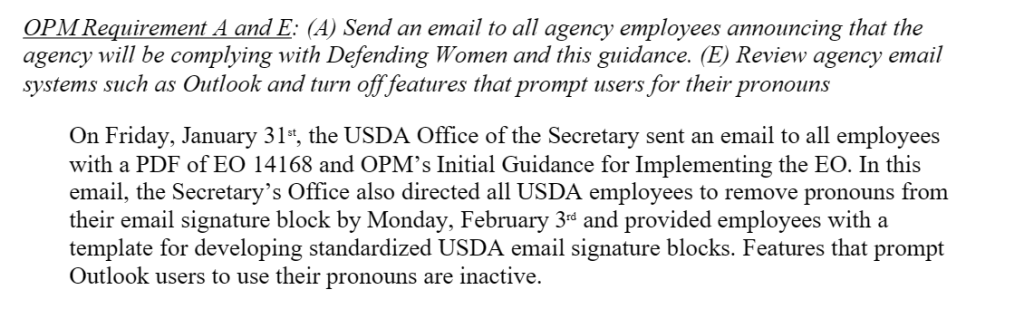
Several days later, the Office of Personnel Management, a White House agency, told departments to describe how they were implementing the executive order. Near the end of the day on Feb. 7, 2025, a USDA official emailed its responses to “defendingwomen@opm.gov.” OPM did not respond to requests for comment.
In addition to the small number of grants located, the USDA told OPM that, like other departments, it had directed all employees to remove pronouns from their email signatures. “Features that prompt Outlook users to use their pronouns are inactive,” the summary reads.
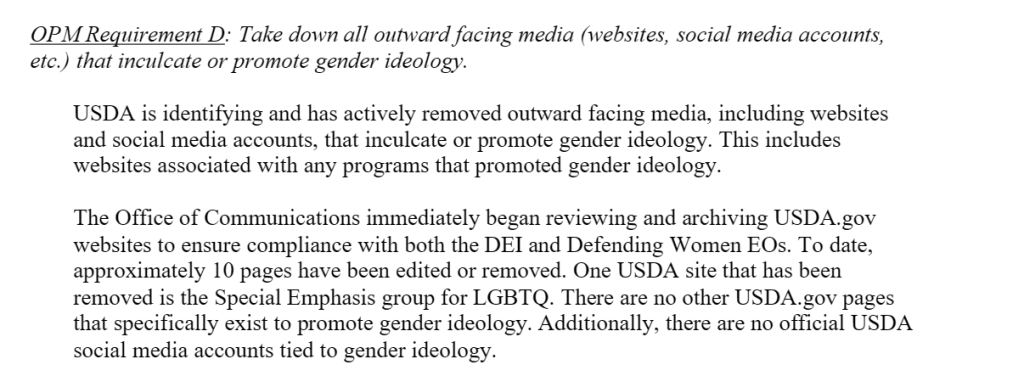
The department was instructed to remove all “outward facing media” that promoted “gender ideology,” but just one existed, according to the summary.
“One USDA site that has been removed is the Special Emphasis group for LGBTQ,” the summary reads. “There are no other USDA.gov pages that specifically exist to promote gender ideology. Additionally, there are no official USDA social media accounts tied to gender ideology.”
Trump officials found other areas that fit the executive order, as well. It canceled about 800 training sessions on AgLearn, the USDA’s internal training portal for employees and contractors, and the department said it would ensure that “intimate spaces are designated male and female” across the USDA’s nearly 23,000 facilities.
Other departments across the federal government have instituted the same bathroom bans for transgender federal workers. In Illinois, a civilian employee of the state’s National Guard was told she could not use the women’s bathroom. She sued, and the case is ongoing.
Looking at the totality of the administration’s efforts related to “gender ideology,” a clear goal emerges, said Harper Seldin, a senior staff attorney at the American Civil Liberties Union’s LGBTQ & HIV Project.
“This is a total campaign against transgender people in every aspect of public and civic life,” he said.
Ag secretary continues push against ‘gender ideology,’ DEI
About a week after the summary was emailed to OPM, Rollins was sworn in as agriculture secretary. In her new role, she continued to focus on what she deemed a widespread problem.
One of her first actions was signing a directive ordering that “no USDA resources (should be) expended, including employee time, in the creation, teaching, promotion, or facilitation of Critical Race Theory, DEIA, or Gender Ideology.”
Then, in early March 2025, Rollins posted to X, the social media site, that a $600,000 grant to study “menstrual cycles in transgender men” had been cut.
“Keep sending us tips,” she wrote. “The insanity is ending and the restoration of America is underway.”
Rollins had mischaracterized the grant, however, according to CBS News. It included a single line acknowledging that transgender men menstruate, but it focused on teaching menstrual health to women and girls. It also sought to develop feminine hygiene products made with cotton and wool.
Rollins soldiered on. Later the same month, in another video on X, she presented seed packets adorned with the phrase, “Growing diversity, equity, inclusion and accessibility at USDA.” With a concerned look, Rollins threw the packets in the trash.
“This is what we’re fighting,” she said.
USDA forced to backtrack on funding cuts after legal scrutiny
When Trump returned to office last year, a main focus was on canceling government funding it deemed objectionable. But at the USDA, the process could be slapdash, and, after cutting many grants, the department was forced to backtrack following legal scrutiny, according to court records.
A DOGE operative named Gavin Kliger spearheaded the funding cuts at USDA. He told staff to include the word “tracking” on the list of words used to cancel funding, according to court records. Kliger has no background in agriculture, but he reasoned tracking fields’ carbon emissions did not benefit farmers. Carbon is essential to soil health, however, and accurate knowledge of how much carbon is retained helps farmers manage their soil and improve yields.
In another instance, school nutrition researchers were told to flag for possible defunding any studies that included the word “class.”
By March 2025, USDA staff had determined that 309 awards fit the definition of DEI outlined in one of Trump’s executive orders, according to an affidavit submitted in a lawsuit against the department.
Then, about a month later, the department unfroze most of the funding, “following the court’s preliminary injunction, and out of an abundance of caution,” according to another affidavit. Now, only 34 awards qualified as DEI. The case is ongoing.
More cuts followed. In June 2025, Rollins announced more than 145 awards, totaling almost $150 million, were canceled because they were “being wasted on woke DEI propaganda.” The USDA only listed three of the awards in its press release.
More recently, the USDA has attempted to tie states’ access to SNAP funding to adherence to the Trump administration’s views on gender. Under the USDA’s plan, states would not be able to promote “gender ideology,” but the department did not “explain what activities are prohibited,” according to court records.
States sued the USDA in March, and they were granted a preliminary injunction in June. The case is ongoing.
Claims of ‘defending women’ are dubious, experts say
The Trump administration has said its actions on “gender ideology” are needed to protect women, but, in other areas, the USDA has curtailed women’s visibility in agriculture.
Earlier this year, in a rare intervention, the USDA rejected four candidates chosen by their peers for positions on the United Soybean Board, a quasi-governmental organization that promotes the commodity, according to Reuters. All four candidates were women.
“It’s a really big deal because it’s just another thing of where the current administration views women, I believe, and what their role should be,” one of the candidates, a Wisconsin soybean farmer, told Reuters.
In previous iterations of the USDA, some women reported feeling their inclusion on USDA boards or committees felt like a box was being checked.
This year is the United Nation’s International Year of the Woman Farmer, a campaign focused on spotlighting the role of women in agriculture around the world. Under President Joe Biden, the USDA spearheaded the U.S.’s participation in the campaign.
Since Trump returned to office, the USDA appears to have done little, if any, work — at least publicly — toward promoting the campaign, and last year an employee in charge of coordinating the USDA’s work on the campaign was fired. The USDA had created a webpage devoted to it, but it has since been removed. (Major farm groups, such as the American Farm Bureau Federation, have embraced the campaign.)
In a statement, the UN said it “works with the US government and USDA on issues related to women farmers, consistent with the support” for a 2024 resolution adopting this year’s campaign. The USDA did not return a request for comment.
Sachs, the Penn State rural sociologist who also serves on a UN panel focused partly on gender, said the administration’s actions show it doesn’t intend to protect women.
“That’s just so duplicitous,” she said.