Key takeaways
- No federal heat protection standards exist. If signed into law, the legislation would make Illinois the eighth state to implement requirements for employers related to extreme heat. It would make Illinois just the third state to have standards related to cold temperatures.
- Extreme temperatures affect workers across Illinois’ food system, from crews detasseling corn in rural areas to sanitation workers cleaning frozen pizza factories in Chicago.
- Organizations representing employers across Illinois’ food system have argued the legislation’s requirements, such as paid water breaks at a certain temperature, could impact supply chains.
Since last year, worker advocates and industry representatives in Illinois have negotiated over a potentially groundbreaking piece of legislation that would require employers to protect laborers from extreme temperatures.
In private discussions, the Illinois Farm Bureau, a powerful lobbying organization for the state’s agricultural industries, voiced concern that the bill would impede farmers' ethical duty to care for their livestock. But, to some participants, one thing seemed to be missing: No mention of workers.

As climate change makes the weather hotter and more volatile, worker advocates have pushed to pass temperature standards into law this year. The legally binding standards in House Bill 3762, such as paid water breaks, are necessary to protect workers’ health and safety — and prevent death — in a rapidly heating world, advocates argue. The bill, introduced by Chicago Democrat Rep. Edgar Gonzalez, is currently being debated in committee.
No federal standard exists to protect workers from extreme heat. The Biden administration began implementing one, but its fate is unclear under the Trump administration, which, in its first term, removed federal webpages linking extreme heat to human health. If the Illinois proposal were to become law, the state would be just the eighth to implement temperature standards.
But the Illinois Farm Bureau has opposed the state proposal since its introduction last year. During negotiations and in a statement to Investigate Midwest, the Farm Bureau argued the legislation would “severely limit” farmers’ ability to care for their animals. The statement did not mention workers.
“Agriculture is already extremely weather reliant,” said Chris Davis, the Illinois Farm Bureau’s director of state legislation. “Adding additional, artificial weather-related restrictions on a farm operation could cripple their ability to manage operations. Farmers have a moral and legal obligation to care for their animals in extreme weather. It is critical that farmers feed, water and protect their animals in extreme weather conditions.”
Extreme heat can have devastating effects on livestock. Illinois ranks fourth in hog production, 20th in cattle production and 23rd in dairy production, according to the 2022 agricultural census. Heat stress in livestock has been linked to low fertility, smaller animals and death, all of which directly affect producers’ bottom lines.
Academic research suggests livestock may be more susceptible to heat stress than humans in the same conditions. Hogs, for instance, lack sweat glands, which inhibit their ability to cool down on their own. To keep livestock healthy during heatwaves, researchers at the University of Nebraska-Lincoln suggest feeding animals at night, installing sprinklers in pens and providing enough water.
But the researchers also emphasized the importance of keeping employees safe. “Maintaining feedlot employee health during a heat crisis is critical,” the researchers wrote in a 2015 paper. “If they are suffering, they can’t do their best to care for the (animals), and managing heat stress can’t be accomplished.”
Data showing heat-related illnesses in specific agricultural industries does not exist, but extreme heat regularly leads laborers to visit hospitals. Across all industries in Illinois between 2017 and 2024, more than 700 workers suffered heat-related injuries or conditions on the job, according to an analysis of hospital data by Brett Shannon, a researcher at the University of Illinois Chicago’s School of Public Health.
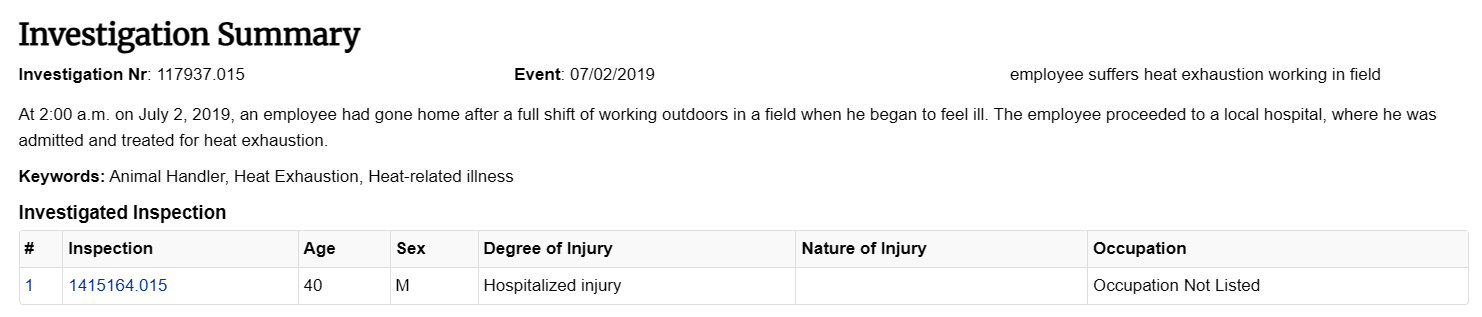
The U.S. Occupational Health and Safety Administration has not recorded a case of an Illinois feedlot employee suffering heat exhaustion over the past two decades. But heat illness can be misdiagnosed, and, sometimes, symptoms can be difficult to notice during the workday. In summer 2019 in Missouri, a feedlot employee finished a full shift, according to OSHA records. Then, at 2 a.m., he began experiencing symptoms and checked himself into a hospital.
Other lobbying organizations that represent employers in the agriculture and food industries stressed, unprompted, to Investigate Midwest in statements and interviews that caring for workers was essential to their businesses. The Farm Bureau did not.
The Farm Bureau declined to grant an interview. Investigate Midwest asked over email if the organization saw a “moral and legal obligation” to workers or, just in general, if it agreed worker safety was “critical.”
“At this time, we will defer to the statement that we initially sent you,” a Farm Bureau spokeswoman said.
Extreme temperatures affect workers across Illinois’ food system
From corn fields in central Illinois to frozen pizza factories in Chicago, workers across the state’s food system contend with extreme temperatures.
Illinois ranks second in corn acreage, according to the U.S. Department of Agriculture, and a major corn processor, Archer Daniels Midland, is headquartered in the state. Among other processed food ingredients, ADM produces the high fructose corn syrup in Coca-Cola’s soft drinks.
As temperatures soar in the summer — with heat indexes sometimes exceeding 100 degrees Fahrenheit — crews detassel corn stalks. The process allows corn companies, such as corporate behemoths Bayer and Corteva, to control pollination, an essential step in crafting high-yield seed varieties.
Yet farmworkers also risk being fired for taking breaks. “I’ve had bosses who, if they see you resting for a few minutes under a tree to recover yourself, think you’re wasting your time and send you home without pay,” a crew leader told Investigate Midwest in 2023.
And water availability is not consistent. Last June, an Illinois state inspector found an employer failed to provide adequate access to drinking water for its crew: “no cooler with cold water with disposable cups for the workers in remote field areas,” according to state records.
At the time, Illinois was in the midst of one of its hottest Junes on record. The specific location of the farmworkers is redacted in the records, but, statewide, the month’s average temperature was more than 2 degrees Fahrenheit above the historical average, according to the Illinois State Climatologist.
The bill would require employers to provide paid breaks and cold water once the National Weather Service’s heat index reading for the area hits 90 degrees Fahrenheit.
The legislation would also implement cold-weather standards, making Illinois the third state to do so. According to the legislation, once the outside temperature reaches a wind chill index of 10 degrees Fahrenheit, employers must provide adequate attire and allow breaks to warm up.
Dairy and nursery workers are some of the most affected by working in Illinois’ wintry conditions because the work is year-round, said Gabriela Gracia, a researcher at the Great Lakes Center for Farmworker Health and Wellbeing at the University of Illinois Chicago. Many workers have to bring their own garments to keep warm, which they may not have or need in their home countries, she said.
“It’s incredibly difficult working in those conditions, especially when they’re coming from Mexico and they come directly into our coldest part of winter,” she said. “They’re outside for eight-to-10 hours a day with little-to-no protection.”
Across all industries in Illinois between 2017 and 2024, just under 200 employees suffered cold-related injuries at work, according to the analysis by Shannon, the University of Illinois Chicago researcher.
In Chicago, workers in the city’s many food manufacturing warehouses also face extreme temperatures, according to worker advocates.
For indoor work, the proposed legislation would require employers to provide protections when the ambient temperature — the air temperature in a given space — is at or below 65 degrees Fahrenheit and at or above 90 degrees Fahrenheit.
Sanitation workers can be exposed to both extremes during the same shift, said Andrew Herrera, with the Chicago Workers Collaborative. At a frozen pizza factory, for instance, a laborer could start cleaning the flash freezer before cleaning an industrial oven that was recently turned off.
“You’ll move from an environment where you’re in sub-zero to above 130 degrees, from one room to the next, which causes a very particular strain on the body,” Herrera said.
In some cases, according to worker advocates, food products might have more protections than employees. Workers of a food production facility that uses apples told Arise Chicago that, when it’s really hot in the summertime, there are rooms dedicated to keeping the fruit chilled.
“The workers are not provided that same accommodation,” said Adam Kader, Arise Chicago’s public policy director. “And the ones that are working in those cooling rooms are not provided with anything to wear.”
Employers worry about effects on supply chain
Organizations representing employers said they were concerned that the legislation could affect supply chains.
Growing hogs and cattle require a regular supply of feed, which Illinois’ grain processors produce. When a train arrives at a grain elevator, the product needs to be loaded on time, said Jeffrey Adkisson, the executive vice president at the Grain & Feed Association of Illinois.
“No matter what the weather is, you got to get that train loaded in a certain period of time or face significant financial penalties,” he said. “We still care for our people. We still stress staying warm, being safe, staying cool when it’s hot, having appropriate clothing.”
Adkisson pointed to another scenario that could slow down a company’s production. Grain elevator operators often clean their bins — the large metallic cylinders dotting rural Illinois — in the summer, which means the temperature inside the bin is hotter than outside.
“You’re getting down to the bottom, and you’re almost done (cleaning): ‘Well, gee, we’ve got to take a break,’” he said. “You just add so many inefficiencies into that system.”
The proposed legislation would also require employers to develop worker safety plans that address extreme temperatures. Industry groups oppose the measure.
Many workplaces already have such plans in place that work for their individual facilities, said Donovan Griffith, the executive vice president and chief strategy officer with the Illinois Manufacturers’ Association, which represents many food production plants.
Employers “understand their employees, they understand their workplace atmosphere, they understand the conditions in which their employees work,” he said. “Giving them the authority to create safety plans and implement them is, we think, the best direction to go.”
The legislation would also implement fines for violating the temperature regulations. First offenders face up to $5,000, and another violation within three years could result in a $15,000 fine.
Under the proposal, employees would also be able to sue companies over not providing a safe work environment related to temperature. Currently, with no legal standard, workers cannot.
“That’s the heart of the problem,” said Kader, with Arise Chicago. “There really isn’t recourse for when people suffer temperature-related injuries.”
Interviews
Email correspondence with Illinois Farm Bureau spokeswoman Sierra Henry from March 25 to April 17, 2026
Emailed statement from Chris Davis, Illinois Farm Bureau, March 31, 2026
Adam Kader, Arise Chicago, April 3, 2026
Andrew Herrera, Chicago Workers Collaborative, April 7, 2026
Jeffrey Adkisson, Grain & Feed Association of Illinois, April 9, 2026
Brett Shannon, University of Illinois Chicago, April 13, 2026
Gabriela Gracia, University of Illinois Chicago, April 13, 2026
Donovan Griffith, Illinois Manufacturers Association, April 13, 2026
News stories
“‘Temperatures continue to rise and farmworkers continue to be at risk,’” Investigate Midwest, Oct. 21, 2021
“Poor regulatory safeguards leave farmworkers suffocating in the face of increasing heat waves,” Investigate Midwest, Aug. 24, 2023
“Dying in the Fields as Temperatures Soar,” Inside Climate News, Dec. 31, 2023
“States Focus on Worker Exposure to Cold Temperatures,” The National Law Review, Dec. 22, 2025
“High temperatures browbeat US as regulators discuss new heat protection rule for workers,” Investigate Midwest, June 24, 2025
“Trump keeps business, labor guessing on heat protections,” Politico Pro, April 10, 2026
Academic research/publications
“Feedlot Heat Stress Information and Management Guide,” NebGuide from Uniersity of Nebraska-Lincoln Extension, August 2015
“Heat Stress in Feedlot Cattle,” Iowa State University Extension and Outreach, June 2018
“Heat Stress Impacts on Cattle,” South Dakota State University Extension, 2020
“Minimizing impacts of higher temperatures on pigs raised outdoors,” Michigan State University Extension, Jan. 27, 2023
“Heat Stress Mitigation Strategies in Feedyards: Use, Perceptions, and Experience of Industry Stakeholders,” Animals, Sept. 26, 2023
“Emergent Occupational Injuries Presenting to Hospital during Increasing and Extreme Heat Days in Illinois (USA),” International Journal of Biometeorology, 2025
“Strategies for mitigation heat stress and their effects on behavior, physiological indicators, and growth performance in communally managed feedlot cattle,” Frontiers in Veterinary Science, Feb. 14, 2025
“June Brought Summer Heat & Storms,” Illinois State Climatologist, July 7, 2025
Government records
“Inspection: 1250777.015 - Jackson-Citrus, Inc.,” Occupational Health and Safety Administration accident report detail, opened July 27, 2017
“Inspection: 1415164.015 - Smithfield Hog Production,” Occupational Health and Safety Administration inspection detail, opened July 10, 2019
“State Profile: Illinois,” 2022 Census of Agriculture
ETA 8429 complaint form, collected by Illinois State Monitor Advocate, dated June 9, 2025 (obtained via public records request)
“Bill Status of HB3762,” Illinois General Assembly website, accessed April 15, 2026
NGO publications
“Occupational Heat Safety Standards in the United States,” National Resources Defense Council webpage, updated on March 9, 2026