Key takeaways
The case: Monsanto Company v. Durnell concerns a lawsuit brought by a Missouri man who claimed the herbicide Roundup caused his cancer. After a Missouri jury awarded him $1.25 million in damages, Monsanto (Bayer) asked the Supreme Court to rule EPA-approval of agrichemicals should trump state-level claims.
What’s at stake?: A win by Monsanto would essentially ban many lawsuits over cancer claims nationwide, despite the company already losing thousands of cases.
Next steps: The Supreme Court is expected to issue a ruling in July.
For Paul Clement, the Virginia-based attorney for Monsanto, his client's ability to sell its popular herbicide products without fear of lawsuits over cancer claims boils down to one simple premise.
“The agency has given us the green light,” Clement told the U.S. Supreme Court Monday.
He was referring to the U.S. Environmental Protection Agency’s conclusion that the herbicide Roundup and its active ingredient glyphosate are not likely to cause cancer.
Meanwhile, thousands of state juries and courts have awarded billions of dollars in damages to farmers and other users who say the popular herbicide has done just that.
Which is why Monsanto brought its case to the nation’s highest court, asking the justices to officially decide whether agrichemical companies are liable for damages at the state level when the EPA hasn’t ordered that their products carry any cancer warning labels as part of an every-15-years review process.
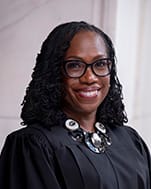
“But if new information comes out (showing a cancer link) … you would have a product that is misbranded, right?” asked Justice Ketanji Brown Jackson, one of the court’s three liberals, appearing to cast doubt on Monsanto’s claim.
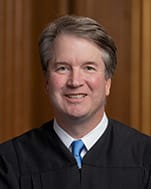
However, Justice Brett Kavanaugh appeared to side with Monsanto as he repeatedly brought up the issue of preemption, which says states can’t override a federal law. Kavanaugh also said that if new science arises, the EPA has a process for responding to it.
Ashley Keller, the attorney for the Missouri-based respondent, argued that states can ban the use of specific pesticide products, so why shouldn’t their own juries be able to award tort relief?
“The law of Missouri and the law of the United States can be the same … and the findings (about pesticide harm) can be different,” Keller said.
The court’s decision, expected in July, could significantly reshape the future of Bayer, the owner of Monsanto and one of the most powerful companies in the farming industry, whose monopoly of seeds and related herbicides has helped the nation’s heartland become a crop-producing power.
Over the last several decades, as the use of pesticides and herbicides has grown to fight insects, weeds and other pests, many farmers and gardeners have increasingly said the chemicals are causing cancer.
Multiple studies have claimed a connection between pesticides and cancer, including one comparing it to smoking and lung cancer.
A map of U.S. counties with the highest cancer rates often mirrors the regions with the highest pesticide use. Of the 500 counties with the highest pesticide use per square mile, 60% of those counties also had cancer rates higher than the national average of 460 cases per 100,000 people, according to an Investigate Midwest analysis of data from both the U.S. Geological Survey and the National Cancer Institute.
This case, “will have enormous consequences for environmental health litigation,” said Tarah Heinzen, legal director for Food & Water, an advocacy group that recently published its own research showing high cancer rates in high pesticide use communities. “This case threatens to close the courthouse doors to the many Americans harmed by pesticides.”
President Trump backs Monsanto
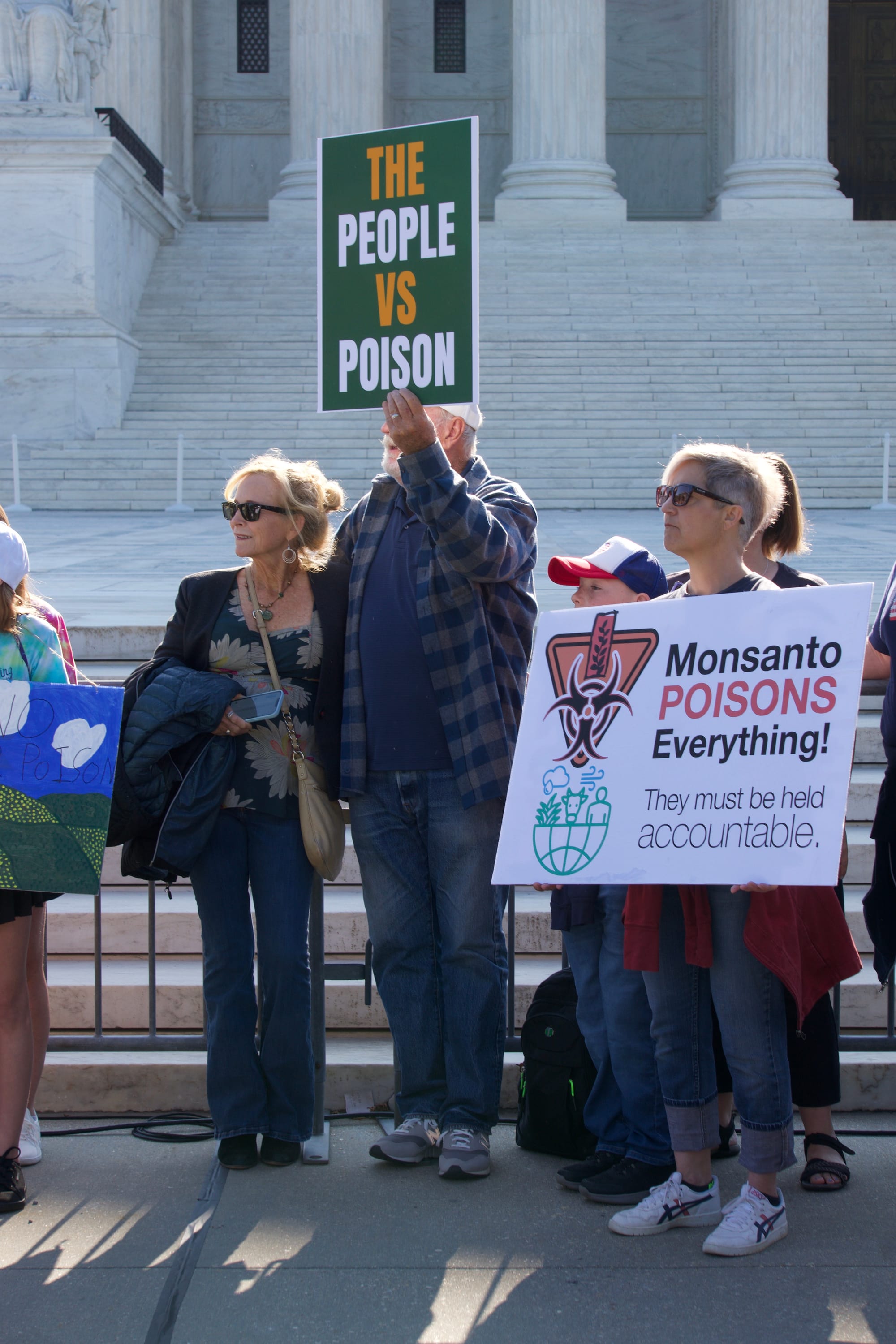
Outside the court building’s west entrance, Vani Deva Hari, author of a blog called the Food Babe, yelled to a crowd of more than 100 protestors that the future of health in America was at stake.
“Monsanto is arguing for the right to poison us and get away with it,” said Hari, who, like many in the crowd, has supported the Make America Healthy Again coalition.
Spearheaded by Secretary of Health and Human Services Robert F. Kennedy Jr., MAHA has pushed against widespread agrichemical use and has been an important base of support for President Trump.
Last year, Kennedy raised health concerns over pesticides in a report widely praised by MAHA leaders. Kennedy even predicted that Trump would stand up to major pesticide companies.
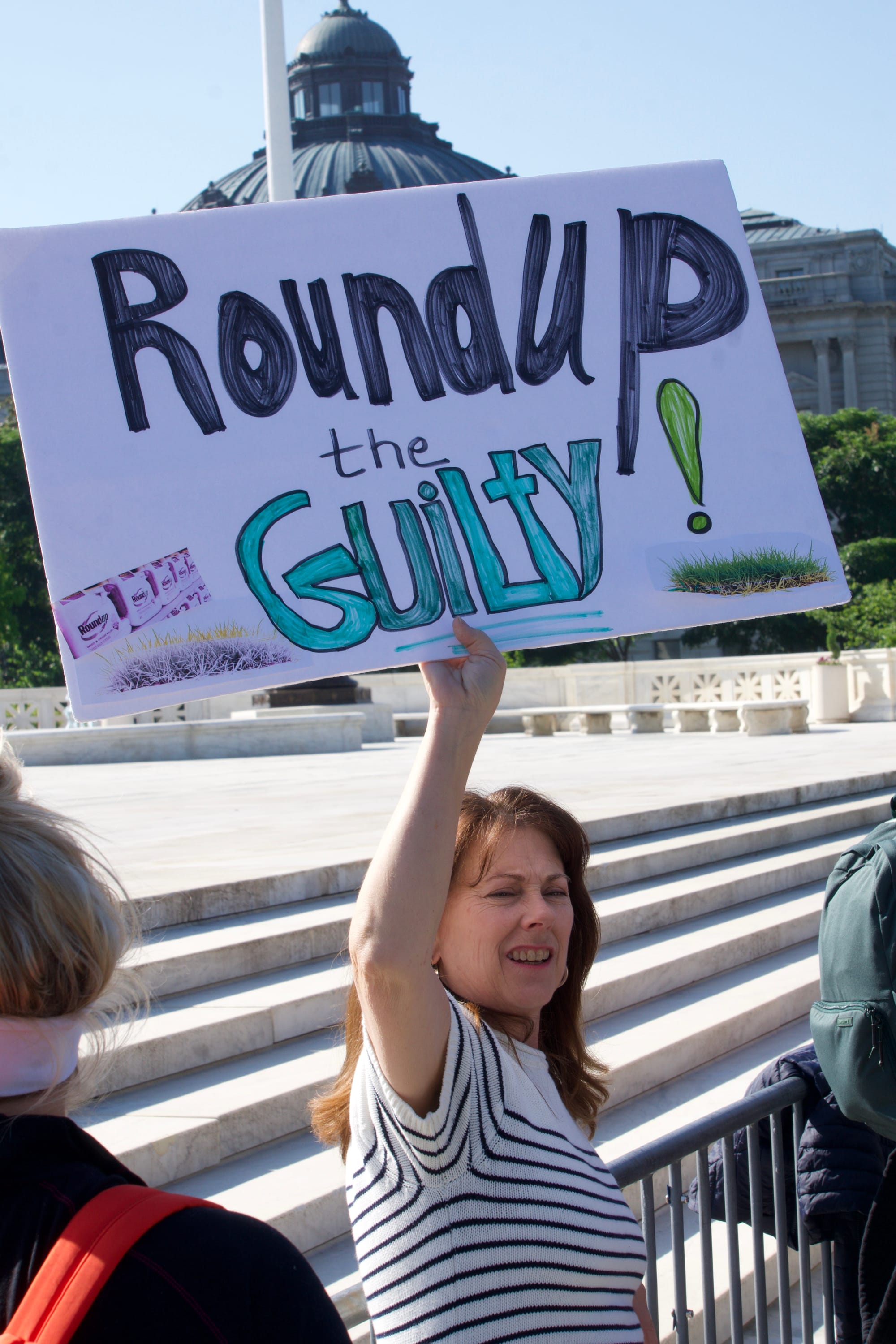
But this year, Trump signed an executive order declaring glyphosate — the important ingredient in Roundup — critical to national security. His administration also sent a lawyer to Monday’s hearing to argue alongside Monsanto.
“We wouldn't be here right now if President Trump didn’t sign that executive order … or (didn’t have an attorney) in that building arguing on Monsanto’s behalf,” Hari said.
Bayer and its supporters hope Trump’s support bolsters its position before the conservative-majority court, which has often sided with corporations over environmental regulations.
However, the court has also shown a willingness to limit the EPA’s authority in an effort to give states more control.
While more than a dozen environmental groups filed briefs opposing Monsanto, several local government organizations also weighed in.
“The statute allows the Environmental Protection Agency (EPA) to approve labels on pesticides that include warnings, but its authority to do so does not limit State and local governments in their authority to devise their own regulations, which can include outright bans on otherwise approved pesticides,” a group of local government advocates, including the Local Government Legal Center, wrote in a brief urging the court not to prevent state-level policies concerning pesticide use. “That authority is both necessary and prudent because a national standard cannot consider local soil, climate, population, and environmental conditions that might warrant different rules on the use of any particular pesticide.”
Siding with Monsanto has been a slate of crop associations and the American Farm Bureau.
While Monday’s hearing could have an impact on thousands of pending lawsuits, it originated with the case of John Durnell, a Missouri man who claimed Roundup caused his non-Hodgkin’s lymphoma.
A Missouri jury sided with Durnell, awarding him $1.25 million in damages. Last year, the Missouri Court of Appeals affirmed the judgment.
But Monsanto then asked the U.S. Supreme Court to take up the case, saying various state and federal courts have disagreed over the issue at the heart of Durnell’s lawsuit.
While Monsanto is pushing for a nationwide ban on lawsuits, it has also lobbied lawmakers in multiple states to enact such bans. Two states, North Dakota and Georgia, passed such laws last year.
States have the power to ban the use of a pesticide, but not enact additional labeling standards, Monsanto’s lawyer argued near the end of Monday’s hearing.
“But if states have the power to ban, why don’t they have the power to provide tort relief?” asked Justice Neil M. Gorsuch.