After a series of E. coli outbreaks sickened more than 160 people who ate romaine lettuce in late 2019, the U.S. Food and Drug Administration launched an investigation. Months later, in March 2020, the agency announced its plan to prevent toxic E. coli outbreaks linked to leafy greens in the future.
WHY IT MATTERS
Ingesting leafy greens with E. coli can cause vomiting and, in some extreme cases, life-threatening diseases.
But in the two years since the FDA's announcement, there have been at least four E. coli outbreaks caused by leafy greens. At least 69 people got sick and 28 were hospitalized.
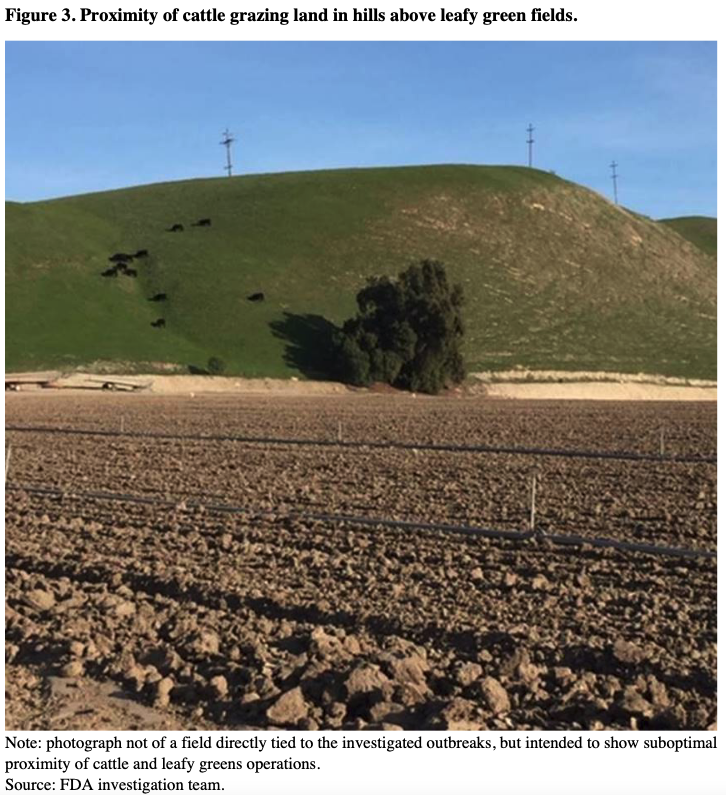
E. coli contamination of crops is difficult to prevent for a number of reasons, experts said, but some food safety advocates want the government to enact stricter regulations, especially regarding the distance between lettuce fields and concentrated animal feeding operations. In April 2021, the FDA called nearby livestock a “recurring safety issue” for the first time.
Jaydee Hanson, policy director for the Center for Food Safety, has advocated for policies that would increase the distance between produce fields and CAFOs in meetings between food safety advocates, the FDA and the U.S. Department of Agriculture.
“That's a challenge because the people operating the CAFOs want to keep operating, and the people growing lettuce want to keep growing lettuce,” he said. “The (question) is, how do you have both?”
E. coli bacteria live in the intestines of humans and animals. Only some strains, like Shiga-toxin producing E. coli, are harmful. STEC can cause severe diarrhea, stomach cramps and vomiting. In the most severe cases, infected people develop life-threatening hemolytic uremic syndrome.
In the two years since the FDA's Leafy Greens STEC Action Plan was announced, the number of recorded outbreaks has been roughly on par with the number of confirmed outbreaks linked to leafy greens for the decade prior to the FDA's plan.
Leafy greens were confirmed as the source in 18 STEC outbreaks between 2009 and 2018, and were the suspected source in 22 additional outbreaks in that time period, according to a study by the FDA and Centers for Disease Control and Prevention.
An FDA spokesperson told Investigate Midwest the FDA is “laser-focused” on reducing the risk of E. coli in leafy greens.
“Our ability to detect foodborne illnesses is better than it’s ever been. And that’s a good thing,” the spokesperson said. “We now have the ability to conduct microbial fingerprints of harmful bacteria found in patients and connect illnesses linked to food that in years past would have gone unnoticed.”
Preventing outbreaks is difficult because the bacteria can be picked up and transferred to fields from a wide range of sources: rainwater runoff, bird droppings, nearby livestock, field workers and irrigation water.
Some food safety advocates like Hanson want government agencies to enforce a greater distance between livestock operations and crop fields, given that cattle manure has been linked to two E. coli outbreaks in recent years.
But industry groups — such as the California Leafy Greens Marketing Agreement, which covers 90% of leafy greens grown in the U.S. — already require a 1 mile “buffer zone” between fields and concentrated animal feeding operations. (It's 30 feet for smaller farms.)
“There is still a lot of work going on in trying to figure out how (outbreaks) happen,” LGMA spokesperson Marilyn Freeman said. “If we knew how to stop it, I can guarantee you we would but there's a lot of things that are taking place — there's still a lot of research being done.”
Because the FDA is better at detecting illness than ever before, it's possible that the agency is finding and publicizing E. coli outbreaks at a higher rate than other kinds of foodborne illnesses, said Sarah Sorscher, deputy director of regulatory affairs at the Center for Science in the Public Interest.
All this attention could make leafy greens seem more suspect than other products, she said.
But some traits of leafy greens do make the crops more susceptible to contamination.
“Fresh leafy greens are generally grown outside, close to the ground, and subject to contamination from air, soil, water, animals, and workers,” the FDA spokesperson said. “Unlike beef, for fresh leafy greens, there is generally no ‘kill step’ because they’re generally eaten raw.”
The STEC action plan, last updated in April 2021, stated the agency would collaborate with government agencies and industry stakeholders to minimize “risks presented by the presence of livestock on adjacent and nearby land” in addition to educating federal and state inspectors on risks posed by land use adjacent to crop fields.
Hanson said the FDA has been slow to address the role of livestock operations in E. coli outbreaks, but that the agency is beginning to change its language and approach to the issue.
For instance, the FDA said stakeholders knew the importance of the agency labeling a certain strain of E. coli — O157:H7 — a "reasonably foreseeable hazard" for the first time in a report on a fall 2020 outbreak. The report also identified livestock as a “recurring safety issue.”
In many ways, the leafy greens industry is ahead of the FDA when it comes to food safety practices, Sorscher said, and farmers often take steps beyond what’s required by the federal government in order to reduce the risk of foodborne illness.
For instance, after an E. coli outbreak caused by Spinach grown in California, farmers created the LGMA under the oversight of the state’s Department of Food and Agriculture to voluntarily raise the bar on food safety practices.
“There's an interest among the whole industry in doing this right,” Sorscher said. “Nobody wants their farm tied to an outbreak. Nobody wants their neighbor's farm tied to an outbreak. So there is a lot of really strong incentive for companies to want to solve the problem.”
Gaps in science, food safety technology limit outbreak prevention
The exact source of E. coli contamination is often hard to determine.
Since January 2021, the FDA has been unable to determine which food products caused three different outbreaks of E. coli illnesses. For example, investigators can run into tracing issues if a person with foodborne illness doesn’t remember every food product they ate in the preceding days or if they threw away the labels on products in their home.
Even when the product is identified, investigators can’t always tell how the product got contaminated in the first place. In the three E. coli outbreaks caused by leafy greens since November 2021, FDA officials haven’t determined where the bacteria came from and how it got into the produce.
In one case, FDA collected STEC samples from farms in Yuma, Arizona, and Salinas, California, but the strains were different from the strain the FDA was investigating, according to a report on a January outbreak caused by packaged salads.
In the 2019 romaine and 2020 leafy greens E. coli outbreaks, FDA officials found matching bacteria strains in cow manure near fields linked to the outbreaks. But the investigators couldn’t figure out exactly how the bacteria reached the fields.
Animals, vehicles, rainwater runoff, rivers and wind all could have transferred the E. coli to the lettuce.
If a farmer doesn’t know how their field was contaminated in the first place, they may not know the best way to keep the bacteria out in the future, Sorscher said.
Testing and treating the water used to irrigate crops, especially in the weeks before harvest, is one way to mitigate the risk of contamination. But most commercially available E. coli tests only detect generic E. coli. While those tests can alert farmers to fecal matter in the water, they don’t signal the presence of pathogenic E. Coli, Sorscher said.
The California LGMA currently requires farmers not using municipal water sources to routinely test for generic E. coli. A new rule proposed by the FDA would require farmers to conduct annual water assessments to identify potential sources of contamination, including nearby livestock operations.
When it comes to treating water, many common water treatments approved by the federal government were developed for use in municipal water sources, which don’t contain sediment, Sorscher said, and if farmers use muddy water in their fields, the treatments may not be as effective.
The FDA's action plan also included steps aimed at improving outbreak response. The agency proposed a rule to require additional recordkeeping throughout the supply chain for foods on the agency’s Food Traceability list, which includes leafy greens. If passed, the rule would streamline investigators’ ability to trace foodborne illnesses back to their source.
Top image: A strain of E. coli involved in an outbreak was also found on this grate near a farm in California, according to an FDA investigation. Photo included in FDA investigation report